Air Layering vs. Traditional Cuttings: Which Actually Roots Ficus, Rubber Plants, and Other Woody Stems
Why Ficus, Rubber Plants, and Other Woody Stems Resist Rooting
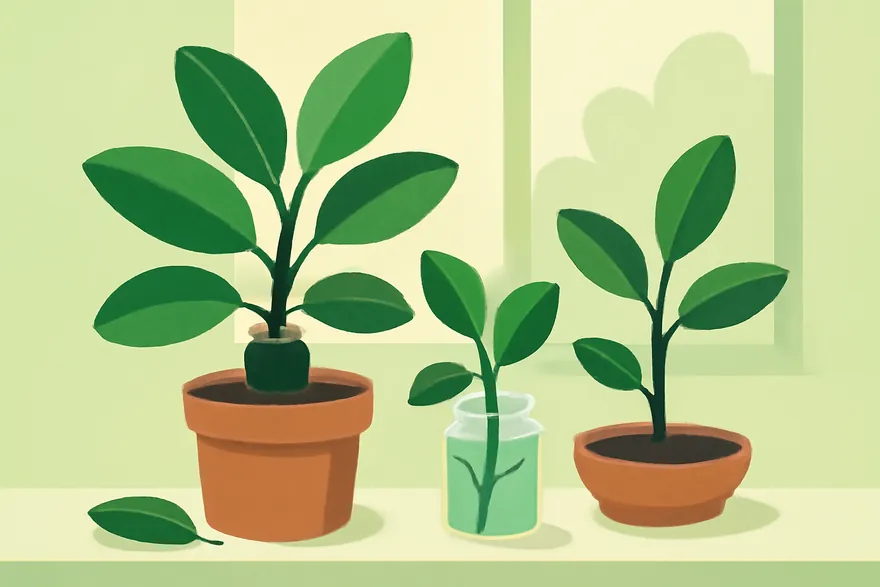
A pothos cutting sitting in a jar of water will often show white roots within seven to ten days. A rubber plant (Ficus elastica) cutting in the same jar can sit for six weeks and rot before it roots at all. The difference is not luck, it is anatomy.
Soft-stemmed plants like pothos, coleus, tradescantia, and philodendron already carry dormant root initials clustered at their nodes. Cut below a node, keep the tissue moist, and those initials wake up fast because the stem is thin-walled, high in stored moisture, and low in lignin.
Woody stems, including ficus, rubber plant, camellia, magnolia, citrus, and many mature hydrangeas, carry almost no pre-formed root initials. Rooting depends entirely on a wound response: the cut surface has to build a callus, then differentiate new root tissue from scratch, a process that typically takes six to ten weeks. Meanwhile the detached cutting is running on stored carbohydrates with no roots feeding it, and ficus species add a complication of their own since the milky latex sap that oozes from a fresh cut can seal the wound and physically block root formation if it is not rinsed away right away.
Put plainly: traditional stem cuttings on hard-to-root woody species succeed maybe fifteen to thirty percent of the time even with rooting hormone, bottom heat, and a humidity dome. Air layering, because it roots the stem while it is still attached to the parent plant and fed by its full root system, routinely clears eighty to ninety percent success on the same species.
Air Layering: Rooting the Stem Before You Cut It
Air layering works because you never ask the stem to survive on its own. You wound it, encourage roots to form right there in place, and only remove the new plant once roots already exist. Nothing has to root under time pressure.
What You Need
- A stem three-eighths of an inch to three-quarters of an inch thick, pencil to thumb width, from wood that grew this season or last. Avoid brand-new soft growth and avoid stems so old the bark has gone corky and thick.
- A sharp, clean knife or box cutter
- Rooting hormone powder or gel with 0.3 to 0.8 percent IBA
- A double handful of sphagnum moss, soaked and then wrung out until it stops dripping
- Clear plastic wrap, or a clear plastic bag cut open and flattened
- Twist ties, electrical tape, or garden twine
Step by Step
- Pick a spot twelve to eighteen inches back from the growing tip, below at least two or three leaves.
- Cut two parallel rings through the bark, one to one and a half inches apart, all the way around the stem, then peel away the bark and the green cambium layer between the rings down to the pale wood underneath. Skipping the cambium is the single most common reason air layers fail. If any of that layer survives, the plant bridges the wound with new bark and never forms roots.
- Rinse off any sap (ficus and rubber plant will bleed white latex) and let the wound dry for ten to fifteen minutes.
- Dust or brush rooting hormone onto the upper cut edge, where new roots will actually form.
- Pack the moist sphagnum moss around the wound in a ball roughly the size of a baseball, covering an inch above and below the cut.
- Wrap the moss tightly in plastic, twist and tie both ends against the stem so no moisture escapes and no water gets in from rain or overhead watering.
- Check weekly starting at week four. Ficus and rubber plant usually show visible white-to-tan roots through the moss by week six to eight; camellia, magnolia, and citrus can take eight to twelve weeks.
- Once you can see a web of roots, not just one or two strands, cut the stem just below the new root ball with clean pruners.
- Pot the rooted top into a well-draining, bark-based mix, keep it under high humidity, a loose bag over the top works, for ten to fourteen days, then transition it to normal care over the following two weeks.
Leave the moss ball mostly intact when potting. The fine new roots tear easily, and a little moss clinging to them does no harm.
When Traditional Cuttings Are Still the Right Call
Air layering is slower to set up, ties up a living stem on the parent plant for a month or two, and only produces one new plant per cut. For plenty of situations, a stem cutting is simply the better tool.
- Soft-stemmed plants with pre-formed root nodes, such as pothos, philodendron, tradescantia, coleus, hoya, and begonia, root reliably in water or a moist mix in one to four weeks, with no hormone required for most of them.
- You need volume. One healthy hoya vine can yield ten or more cuttings in an afternoon; the same vine air layered gives you exactly one new plant, weeks later.
- Softwood cuttings from woody ornamentals taken in late spring or early summer, while the new growth is still flexible and not yet fully lignified, root far better than the same species cut in winter. Hydrangea, forsythia, and many viburnums can hit sixty to eighty percent success this way with rooting hormone, bottom heat around seventy to seventy-five degrees Fahrenheit, and a humidity dome, even though the same techniques barely move the needle on ficus or rubber plant.
- The parent plant can spare the stem tissue without looking damaged, and speed matters more than a guaranteed result.
Quick Decision Guide
- Leggy rubber plant or fiddle leaf fig you want to restart at a lower height: air layer the top, then cut once rooted. The parent will usually resprout below the cut.
- Camellia, magnolia, or citrus you have failed to root from cuttings before: air layer instead of trying a fourth batch of cuttings.
- Pothos, philodendron, coleus, tradescantia, hoya: skip air layering entirely, a simple cutting is faster and just as reliable.
- Hydrangea, forsythia, viburnum: try softwood cuttings first in late spring, and fall back to air layering only if repeated batches fail.
- You need many plants from one parent quickly: cuttings, every time. Air layering only ever gives you one plant per stem.
- You have one valuable, hard-to-root specimen and cannot afford to lose it to a failed cutting: air layer it instead.
Mistakes That Sink Either Method
- Leaving any cambium behind on an air layer, so the wound heals over instead of rooting. Scrape it until the wood looks dry and pale, not green or slick.
- Packing moss too wet. It should feel like a wrung-out sponge, not a dripping one. Waterlogged moss rots the stem before it roots.
- Wrapping too loosely, so the moss dries out between checks. A gap at either end will dry the ball out within a week in a heated home.
- Taking woody cuttings from fully hardened, older wood instead of the current or previous season's growth. It roots at a fraction of the rate.
- Skipping rooting hormone on genuinely hard-to-root species. It will not save a bad technique, but it measurably raises success on borderline ones.
- Checking an air layer by squeezing or unwrapping it every few days. The new roots are fragile, and repeated disturbance is a common reason layers that were rooting well suddenly stall.
Quick comparison table for: Air Layering vs. Traditional Cuttings: Which Actually Roots Ficus, Rubber Plants, and Other Woody Stems
| Section | What to check | How to use it |
|---|---|---|
| Why Ficus, Rubber Plants, and Other Woody Stems Resist Rooting | Match the conditions and warning signs in this section | Use as a quick practical checklist |
| Air Layering: Rooting the Stem Before You Cut It | Match the conditions and warning signs in this section | Use as a quick practical checklist |
| What You Need | Match the conditions and warning signs in this section | Use as a quick practical checklist |
| Step by Step | Match the conditions and warning signs in this section | Use as a quick practical checklist |
Questions and answers
Why is traditional cutting less reliable for ficus and other woody plants?
Many woody stems have few pre-formed root initials, so they must build a callus and then generate new roots from the wound, which usually takes six to ten weeks. During this time the detached cutting has no parent-fed roots, and in plants like ficus or rubber plant, fresh latex can seal wounds and block root formation. As a result, traditional cuttings can succeed only about fifteen to thirty percent of the time even with hormone, heat, and humidity.
What should I do if I need many plants quickly from one plant?
Use cuttings when volume matters, because one stem can yield multiple cuttings, especially with soft-stemmed and reliable species. The article notes that air layering usually produces only one new plant per stem and takes several weeks to establish before cut-off. For this reason, softwood cuttings from hydrangea, forsythia, or viburnum in late spring with hormone, heat, and a humidity dome can be the faster route when timing is important.