How to Root Cuttings in Water vs Soil: Which Method Wins by Plant Family
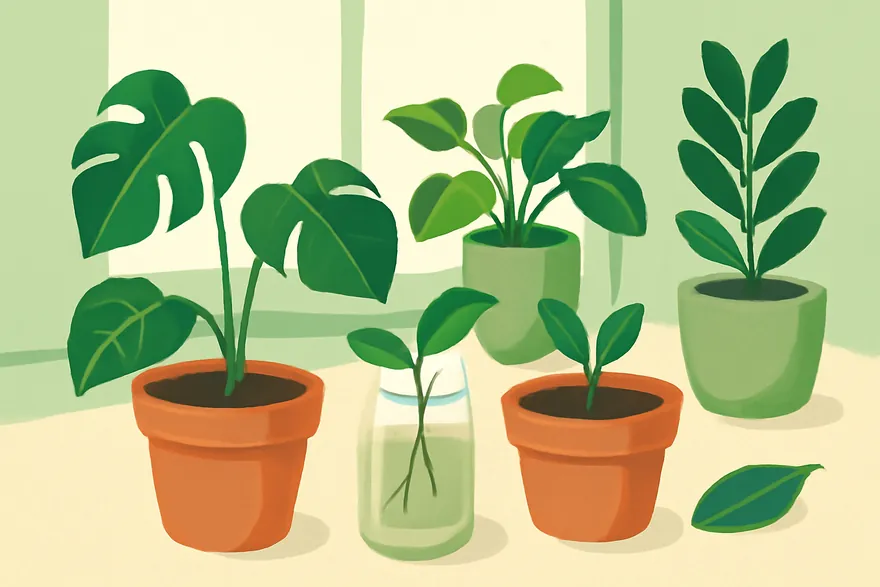
Why the Same Cutting Roots Differently in Water and Soil
A stem cutting does not grow one universal type of root — it grows roots suited to whatever medium first surrounds the cut. Roots that form underwater are thin, glassy, and nearly hairless, built to pull in already-dissolved oxygen and nutrients. Roots that form in soil are shorter, thicker, and covered in root hairs that scavenge for moisture and minerals locked in solid particles. This is why a cutting rooted in a jar on the windowsill can look impressively hairy after two weeks, then stall or die back within days of being potted up. The plant has to grow an entirely new, soil-adapted root system before it can function normally, and many species never manage the switch.
That transition cost is the single biggest reason growers get inconsistent results comparing the two methods. Water rooting is not inherently better or worse than soil — it produces a different intermediate product, and whether that product survives the move to potting mix depends heavily on the plant family.
Which Method Wins for Each Plant Family
Success rates below are practical ranges from repeated home propagation, not lab figures — but they hold up consistently enough to plan around.
- Araceae — pothos, philodendron, monstera, pilea: Water is the reliable default. Nodes root in 7 to 21 days with a success rate around 90 to 95 percent, and the water-to-soil transition is smooth because these species keep growing new roots readily after potting. Skip soil rooting here unless you're propagating dozens at once and need the bench space.
- Lamiaceae — mint, basil, coleus, sage: Also excellent in water, often rooting in 5 to 10 days, but the resulting roots are noticeably weaker than soil-grown ones. Expect 15 to 25 percent of water-rooted mint and basil cuttings to wilt hard for 2 to 3 days after potting up; keep them shaded and misted through that window rather than assuming they've died.
- Crassulaceae — echeveria, sedum, kalanchoe, jade: Water is a poor choice and often fatal. These stems already store water internally, and prolonged submersion triggers stem rot before roots ever form. Let the cut end callus over in dry, open air for 2 to 5 days depending on stem thickness, then root directly in a fast-draining mix. Success rates in soil run 80 to 90 percent versus well under 50 percent in water for thick-leaved succulents.
- Rosaceae and other woody stems — roses, hydrangea, viburnum: Soil wins decisively once the wood has started to firm up, at the semi-hardwood stage. Dipped in rooting hormone and stuck into a perlite-heavy mix under a humidity dome, semi-hardwood rose cuttings root at roughly 60 to 75 percent. The same cuttings left in plain water frequently callus without ever producing real roots, or produce a handful of weak threads that snap the moment you try to pot them.
- Gesneriaceae — African violet and streptocarpus leaf cuttings: Water rooting works for the first stage — a leaf will throw roots in 3 to 4 weeks — but the roots are so fine that potting up kills 20 to 30 percent of them through transplant shock. Rooting the leaf petiole directly in a moist perlite-vermiculite mix from the start avoids that second transition and produces plantlets with a noticeably higher survival rate.
The Most Common Failure Points in Each Method
Water rooting failures
- Bacterial rot at the stem base shows as a soft, brown-to-black mush right where the stem meets the waterline, usually within 4 to 7 days. It's driven by bacteria multiplying in stagnant water, not by the water itself — change the water every 2 to 3 days and this failure mode nearly disappears.
- Algae buildup — a green film on the jar walls — signals too much direct light hitting the water. It doesn't usually kill the cutting outright, but it competes for oxygen and slows rooting. Switch to a tinted or opaque container and keep it in bright but indirect light instead.
- Roots that snap during potting are common because water roots are brittle by nature. Pot up as soon as roots reach an inch or two with a few branching points rather than waiting for a dense mass — longer roots just mean more surface area to break.
Soil rooting failures
- Damping off is a fungal collapse at the soil line that turns the stem black and mushy, almost always caused by a dense, poorly-draining mix combined with overwatering. Use a mix that's at least 40 to 50 percent perlite or coarse sand, and water only when the top inch has dried out.
- Invisible rot is the risk soil rooting carries that water rooting doesn't. You can't see the cut end, so a rotting cutting often looks fine right up until it suddenly wilts. A gentle tug test at 3 to 4 weeks — resistance means roots have formed — catches this before you waste more time on a dead cutting.
- Underwatering during the rooting window can be fatal fast, since a cutting with no roots yet has no way to pull up moisture. Soil that dries out completely even once can kill a cutting in the first 10 days. A humidity dome or a loosely tented clear bag solves this without keeping the mix soggy.
Getting Better Results However You Root
- Cut just below a node at a 45 degree angle with a clean, sharp blade — a crushed or ragged cut invites rot in either medium.
- Strip any leaves that would sit below the waterline or soil surface; submerged or buried foliage rots and takes the stem down with it.
- For soil rooting, dip the cut end in rooting hormone powder or gel before inserting it; for water rooting, hormone gives little benefit and can cloud the water faster.
- Keep both methods out of direct sun. Bright, indirect light speeds rooting; direct sun overheats water jars and dries out soil faster than new roots can compensate.
- Label the date. Most soft-stemmed cuttings that are going to root do so within 3 weeks; if nothing has happened by week 5, the cutting has likely failed and is worth discarding rather than nursing indefinitely.
Transitioning Water Roots to Soil Without Losing the Cutting
Moving a rooted cutting from water into a pot is where a surprising number of home propagators lose plants they had already successfully rooted. The hairless, brittle roots grown underwater are simply not built for the mechanical resistance and drier conditions of soil, so treat the move as a second, gentler propagation stage rather than a one-step transplant.
- Pot into a light, well-draining mix rather than dense garden soil — the loose texture mimics some of the low resistance the roots grew accustomed to in water.
- Keep humidity elevated for the first 7 to 10 days with a loose clear bag or a spot in a more humid room, since the hairless water roots can't yet pull moisture efficiently from soil.
- Expect and ignore mild wilting in the first 48 to 72 hours; it's normal root-type transition stress rather than a sign the cutting is dying, provided the stem itself stays firm.
- Resist the urge to fertilize for the first two weeks — a root system mid-transition can't process the added salts, and fertilizing too early raises failure rates.
Quick comparison table for: How to Root Cuttings in Water vs Soil: Which Method Wins by Plant Family
| Section | What to check | How to use it |
|---|---|---|
| Why the Same Cutting Roots Differently in Water and Soil | Match the conditions and warning signs in this section | Use as a quick practical checklist |
| Which Method Wins for Each Plant Family | Match the conditions and warning signs in this section | Use as a quick practical checklist |
| The Most Common Failure Points in Each Method | Match the conditions and warning signs in this section | Use as a quick practical checklist |
| Water rooting failures | Match the conditions and warning signs in this section | Use as a quick practical checklist |
Questions and answers
Which plant families should I root in water versus soil?
The article says Araceae (pothos, philodendron, monstera, pilea) are reliable in water, with roots in 7 to 21 days and success around 90 to 95 percent, and a usually smooth water-to-soil transition. Crassulaceae (echeveria, sedum, kalanchoe, jade) are poor in water and often fail there, so they should be rooted in a fast-draining soil setup instead.
What problems happen most often and how can I avoid them?
In water, bacterial stem-rot appears as soft brown-to-black mush near the stem-water line, often inside 4 to 7 days, and is usually controlled by changing stagnant water every 2 to 3 days. In soil, damping off and invisible rot are common if the mix is dense and wet, so use a loose, perlite-heavy mix and water only when needed.