Rooting Hormone: Which Cuttings Actually Need It (and Which Don't)
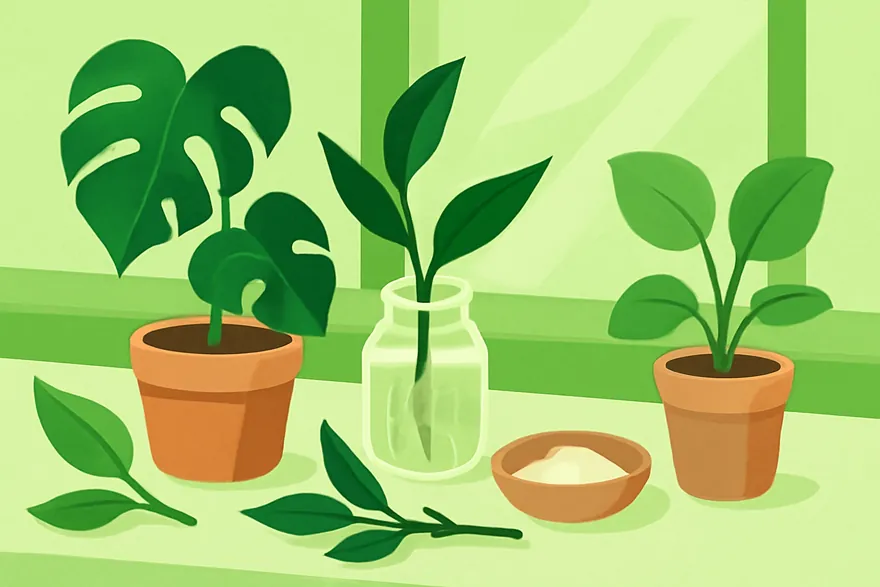
What Rooting Hormone Actually Does
Rooting hormone powder, gel, and liquid all deliver a synthetic auxin, usually indole-3-butyric acid (IBA) or a blend of IBA and naphthaleneacetic acid (NAA), to the cut surface of a stem. Auxin is the signal that triggers cells near the wound to dedifferentiate and start forming root initials. Every cutting already produces its own auxin at the growing tip and moves it downward toward the cut end; commercial hormone simply adds more, faster, in a concentrated dose.
That matters very differently for two groups of plants. Some species produce so much natural auxin and so many rooting cofactors, phenolic compounds that work alongside auxin, that added hormone barely changes the outcome. Others produce little auxin on their own or actively resist forming new roots, and for those, hormone is the difference between a cutting that strikes and one that just sits there and rots.
Concentration matters as much as presence. Powders are usually sold in three strengths: around 1,000 ppm IBA for soft, fast-rooting growth, 3,000 ppm for semi-hardwood, and 8,000 ppm or higher for hardwood and genuinely difficult woody species. Using a high-strength powder on an easy cutting like coleus can actually scorch the cut tissue and cause blackening instead of roots.
Cuttings That Root Fine Without Any Hormone
These plants root reliably in plain water or damp perlite with no additive at all, often at 80 to 100 percent success:
- Pothos (Epipremnum aureum) roots from a node in water in 7 to 14 days, no exceptions needed.
- Coleus shows visible root nubs in 5 to 7 days in water; hormone gives no measurable speed advantage in home trials.
- Tradescantia (wandering jew and zebrina types) roots within a week from almost any node.
- Pilea peperomioides (Chinese money plant) pups and stem cuttings root in water in 2 to 3 weeks unaided.
- Mint, basil, and most soft-stemmed herbs root in water in under 10 days.
- Willow (Salix species) roots so easily that soaking other cuttings in cut willow stems, so-called willow water, is a folk substitute for hormone; willow tissue is naturally rich in auxin precursors and salicylic acid.
- Begonia (rex and cane types), impatiens, and fuchsia softwood tips routinely hit 90 percent or better rooting with nothing but moist mix and humidity.
For all of these, a rooting hormone will not hurt, but it will not meaningfully raise the success rate either. If a cutting from this list is rotting instead of rooting, the problem is almost always excess moisture, low light, or a stem left in stagnant water too long, not a lack of hormone.
Cuttings That Need Hormone to Root Reliably
A different group of plants has low natural auxin transport or high internal rooting inhibitors, and skipping hormone here often means a rooting rate under 20 percent instead of 60 to 80 percent. Trials on woody ornamentals consistently show this gap:
- Rhododendron and evergreen azalea: semi-hardwood cuttings taken in summer typically need 3,000 to 8,000 ppm IBA; untreated cuttings of many cultivars root below 15 percent.
- Lilac (Syringa vulgaris): one of the most hormone-dependent ornamentals; even with 3,000 ppm IBA, softwood cuttings taken at the wrong stage, meaning the shoot has already hardened even slightly, will fail regardless of hormone.
- Japanese maple (Acer palmatum): semi-hardwood cuttings need 3,000 to 5,000 ppm IBA plus bottom heat; untreated cuttings commonly callus over without ever forming roots.
- Camellia: needs 3,000 to 8,000 ppm IBA and consistently takes 8 to 12 weeks to root even with treatment.
- Junipers, arborvitae, and other conifers: hardwood cuttings taken in late fall or winter need 8,000 to 20,000 ppm IBA as a powder or quick liquid dip; rooting percentage commonly jumps from around 20 percent untreated to 70 percent or higher with hormone.
- Hybrid tea and grandiflora roses grown own-root respond strongly to 3,000 ppm IBA gel; many landscape and species roses root fine without it, but modern hybrid teas mostly do not.
If you are propagating from this list without hormone and getting nothing but blackened stem ends after four to six weeks, that is not a technique failure, it is a missing ingredient. Buy a 3,000 ppm IBA powder or gel before trying again rather than repeating the same cutting method.
How to Apply It So It Actually Works
- Make a fresh, clean diagonal cut with sharp bypass pruners right before dipping; hormone applied to a cut surface that has already started to dry and callus over will not absorb properly.
- Pour a small amount of powder into a separate dish. Never dip a cutting straight into the original container, since that introduces moisture and plant pathogens that can spoil the whole jar.
- Dip the bottom half inch to inch of the stem, tap off the excess, and insert immediately into pre-moistened mix. Excess powder caked on the stem can block water uptake and rot the base instead of helping it.
- For gels and liquids, follow the same fresh-cut and immediate-insertion rule; liquid quick-dips of five to ten seconds are the standard method for conifers and other hardwood cuttings.
- Keep humidity high with a clear bag or propagation dome, and hold bottom heat around 70 to 75 degrees Fahrenheit for the woody, hormone-dependent species above. Hormone cannot compensate for cold, dry conditions.
When Skipping It Is the Smarter Call
Rooting hormone powder past its expiration date, or one that has sat open and exposed to humidity for more than a year, loses potency and can be worse than using nothing, since a partially degraded product gives inconsistent results cutting to cutting. If your powder is old, either replace it or skip it entirely for easy rooters rather than trusting a weak dose.
For the easy-rooting houseplants listed above, saving hormone for the plants that genuinely need it is also just efficient: a small jar of 3,000 ppm IBA powder, used only on woody and semi-hardwood cuttings, lasts several seasons instead of being used up on pothos and coleus that never needed it in the first place.
Quick comparison table for: Rooting Hormone: Which Cuttings Actually Need It (and Which Don't)
| Section | What to check | How to use it |
|---|---|---|
| What Rooting Hormone Actually Does | Match the conditions and warning signs in this section | Use as a quick practical checklist |
| Cuttings That Root Fine Without Any Hormone | Match the conditions and warning signs in this section | Use as a quick practical checklist |
| Cuttings That Need Hormone to Root Reliably | Match the conditions and warning signs in this section | Use as a quick practical checklist |
| How to Apply It So It Actually Works | Match the conditions and warning signs in this section | Use as a quick practical checklist |
Questions and answers
Which plants usually root fine without any rooting hormone?
The article says pothos, coleus, tradescantia (wandering jew and zebrina), Pilea peperomioides, mint, basil, willow cuttings via willow water, and begonia, impatiens, and fuchsia softwood tips root reliably without hormone in water or moist mix. It also notes these plants often do not gain a meaningful success-rate increase from hormone, with poor results usually tied to excess moisture, low light, or stagnant water.
Which plants are more likely to need hormone and how should it be applied?
Rhodo, evergreen azalea, lilac, Japanese maple, camellia, junipers, arborvitae, and many modern hybrid tea or grandiflora roses are described as hormone-dependent. The text links these groups to poor untreated results and recommends applying fresh-cut stems only, dipping only the bottom portion, tapping off excess, then planting immediately; excess powder on the base can block uptake and rot the stem.